• Skip to main content

The Seabourns

  • Home
  • Blog
  • About Us
  • About God
  • Give

Keith Seabourn

Online meetings not a church

August 20, 2010 by Keith Seabourn Leave a Comment

I read an interesting blog post today over at ChurchCrunch. Based on a federal court ruling, online worship is not a church.

Very interesting. I wonder if candidate websites are not politics, hence do not qualify for use of campaign funds to operate? If Amazon.com is not business, hence the discussion about collecting sales tax should cease to be an issue?

If activities are defined by traditional trappings, then where do we draw the line?

Update: Reading the full journal article here, which is written in a very readable style, is helpful and enlightening. A critical issue in the court’s opinion is that the worshipers were not associating together in some form. So if worshipers are interacting through messages, tweets, etc., then perhaps the legal definition is different. The article makes a very good note that legally-required board meetings of for-profits and non-profits are often conducted by virtual technologies.

Filed Under: ccc, Ministry, Thoughts Tagged With: social media

Could Twitter measure spiritual climate?

August 9, 2010 by Keith Seabourn 1 Comment

This article has me thinking: Is Twitter a national mood ring?

So, I’m intrigued: Could Twitter be used to monitor the spiritual climate of a target area over time?

I know someone who uses Twitter to identify hurting people who might be more open to spiritual conversations. He uses Twitter’s geographic search to look for people in his zipcode area and nearby areas. He searches for words like “suicide” or “depressed” or “divorce”. He then direct messages them a short encouragement. If they respond, he engages in direct message ministry. Because they are nearby, he can invite them to his church, or to an event, or something more geographic.

This paragraph intrigues me:

In fact, other research groups have also begun to examine Twitter data and have demonstrated that it can be used to predict the box-office success of an upcoming movie. And Twitter data yields much more detailed polling when compared to traditional methods, enabling real-time feedback for issues that are of local, national or international interest.

This person first did this as a job for a local politician, finding prospective supporters and donors based on issues, filtered by the geographic area of the politician.

So, I wonder about spiritual issues. I wonder if it is a way to “measure” the impact of a billboard campaign or a Jesus Video distribution or other ministry strategies.

What do you think?

Filed Under: ccc, gto, Ministry Tagged With: social media

God’s gift of technology

August 8, 2010 by Keith Seabourn Leave a Comment

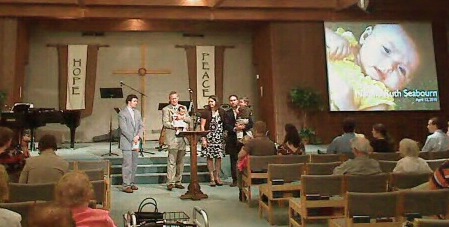
Natalie's dedication

Kay and I are attending church in Dallas, Texas. But we’re sitting on our couch in Orlando, Florida as I write this. Participating in church over the internet is not so amazing any more. People rarely think twice about it.

But today is our granddaughter N’s dedication day.

And through God’s gift of technologies like the internet and Skype, we’re participating in dedicating our little N to God.

Jonathan and Meredith’s church doesn’t broadcast their service. It’s a small church. But through God’s gift to his church today, it only takes a laptop computer, an internet connection, Skype and a webcam (fortunately, a high-definition webcam).

We are using some of God’s communication technology gifts to lead people into a personal relationship with Jesus, to help train and grow strong followers, and providing many opportunities for believers to engage in helping others know Jesus. I’ll write more in other posts.

Now, it’s back to dedicating N, committing to helping her grow up as one of God’s beautiful princesses.

Filed Under: Personal Tagged With: technology

Mutuality is important

August 4, 2010 by Keith Seabourn Leave a Comment

The Meeting of the WatersI’m currently reading The Meeting of the Waters: 7 Global Currents that will Propel the Future Church. It’s a good book for those engaged in missions. It’s particularly a good book for those of us who have been in missions for many years and can benefit from seeing with another’s eyes.

I’ve read the chapters on mercy, mutuality and migration. I strongly agree with the author that mutuality is crucial to the meeting of the waters of traditional and current, of the north and the south, of what the Lord has done and what he is doing today. Read the author’s explanation of mutuality below…

Q: What are the seven trends that are having an impact on Christianity?

A: Mercy. Mutuality. Migration. Monoculture. Machines. Mediation. Memory.

Q: What is the single biggest shift in ministry that today’s churches are facing?

A: I’m not comfortable choosing just one, because various ones or others loom prominent in different countries or cities at different times. That is, after all, one of the most important lessons of The Meeting of the Waters-that Christians in all countries should become adept at recognizing how their country’s Body, and its witness, is being differently affected by global trends. But, since you asked, I will say that the most important Global Current is Mutuality, because it is the necessary foundation for all global ministry work. Mutuality means that believers from traditionally powerful countries (that means Americans and Europeans, for starters) must include and look to Christians from traditionally weaker countries. People from less-developed countries (think India and China) increasingly have education, technology, ability to travel, trained and plentiful workforces…and confidence. Those brothers and sisters also have spiritual experiences and depth that come from generations of suffering and wanting, and as an American I know I need to learn about that. Not only is Mutuality the right choice for Christians, it is increasingly the only choice in our flattening world. And the great news is that it is also fun, for I have found Mutuality to be one of the most thrilling and expanding journeys in my Christian life.

The blending of those who can offer the power of organization, funding, program management, a we-can-make-a-difference-perspective and the power of deep spiritual experience and lifestyle flowing from want and need and suffering and having little materially. Exciting stuff!

Filed Under: ccc, Thoughts Tagged With: missions

A Discernment Process for Spiritual Leadership

August 2, 2010 by Keith Seabourn 3 Comments

I’m nearing the end of Ruth Haley Barton’s excellent book Strengthening the Soul of Your Leadership. In Chapter 12, Finding God’s Will Together, she outlines a process for discerning God’s will as a group. The emphasis is on discernment. I’ve used some of these before, but I found this to be the best explanation and most complete process I’ve heard described.

I really appreciate Barton’s emphasis on both solitude and group. I really appreciate her statement that combines spiritual community with spiritual leadership.

You get somewhere by discerning God’s will and doing it together.

  1. Clarify the question for discernment.
  2. Assemble the community of wise stakeholders who have used discernment processes in their individual lives. Involve people who are committed to the process of personal transformation, who have experienced personal discernment in their own decision-making.
  3. Establish or re-affirm guiding principles that will govern the process. Discernment at the leadership level requires an extraordinary amount of safety in the group process. Trustworthy relationships are crucial. Discuss and agree on the values.
  4. Begin with a prayer of quiet trust. Barton suggests this from the Book of Common Prayer:

    Oh God, by home we are guided in judgment,
    and who raises up for us light in the darkness:
    Grant us, in all our doubts and uncertainties,
    the grace to ask what you would have us to do;
    that your spirit of wisdom may save us from all false choices,
    and in your straight path we may not stumble;
    through Jesus Christ our Lord; Amen.

  5. Pursue a state of indifference to anything but God’s will — nothing more, nothing less, nothing else. Ask “What needs to die in me in order for the will of God to come forth in and among us?”
  6. Listen on many levels. Listen to our experiences. Listen to inner promptings by the Holy Spirit. Listen to fact and information. Listen to testimony from those most affected. Pay particular attention to distress, confusion, desolation and difficult emotions.
  7. Listen within through periods of silence. Break up group meetings with periods of individual “listening prayer” where individuals spend time in silence focusing on a common passage, then share with each other what they heard from God from this passage regarding the question for discernment. Not all may hear something specific, while others may. Listen as a group to what each shares he or she heard from God. Manage group dynamics through periods of individual solitude. Allow dysfunctions to be named. Allow periods for self-awareness.
  8. Select an option consistent with what God is doing among the group. If no single option stands out, identify 2 or 3 options and refine them. Ponder the options to see which sit well with the group, which bring consolation or desolation. Seek inner confirmation.
  9. Agree together. Unity is the fundamental marker that God’s will has been discerned. As an expression of faith, thank God together for his presence and his gift of discernment.

You get somewhere by discerning God’s will and doing it together.

What do you think? How have you used a discernment process for hearing God’s direction and doing it?

Filed Under: ccc, Leadership Tagged With: Leadership

  • « Go to Previous Page
  • Page 1
  • Interim pages omitted …
  • Page 20
  • Page 21
  • Page 22
  • Page 23
  • Page 24
  • Interim pages omitted …
  • Page 73
  • Go to Next Page »

Copyright © 2025 · Parallax Pro on Genesis Framework · WordPress · Log in