• Skip to main content

The Seabourns

  • Home
  • Blog
  • About Us
  • About God
  • Give

Keith Seabourn

Sharing Your Story

May 21, 2016 by Keith Seabourn Leave a Comment

Paul before Agrippa

I met Joseph last Sunday. He was easy to spot. The Sunday School class I was visiting is helping him walk the path back into connectedness after some time on the street.

Kay and I were speaking about our ministry with Global Church Movements. He asked if we could talk. He wants to influence people he knew while on the street but doesn’t feel he is getting through to them. He wanted to know how to get into ministry more like Kay and I described.

I encouraged him to develop his personal story into a powerful tool that he can share with those he has known. We talked through a shortened version of one of the sessions we teach on sharing your personal story (testimony). I asked him to read Acts 22 and Acts 26. Paul shares his story. I encouraged him to look for this structure in Paul’s story: 1) my life before receiving Christ, 2) how I received Christ and 3) my life after receiving Christ.

I asked Joseph to read Paul’s story out loud and time how long it took using a clock or watch. I told him that most readers can read Acts 22 (about 400 words) in about 3-4 minutes and Acts 26 (about 600 words) in 5-6 minutes. So if Paul can tell his story in 4-5 minutes, then why can’t we also work to develop a version of our story (about 400-500 words) to share in 3-4 minutes?

I encouraged him to think of one word that best described his life before Christ, one word that described how he come to know Christ, then one word that describes his life after receiving Christ. Then write 3-4 sentences expanding thoughts for each word. This will help him write a story that is focused around these 3 big ideas and flows smoothly. I suggested he practice telling this story until it is natural and he can tell his friends. I reminded him that, like Paul, he is not preaching a sermon but telling what God has done in his life.

Joseph was encouraged. He said that he’s tried telling his friends but he got lost and used too many words. He likes this idea and will work on it.

What about you? Do you have a 3 minute way to tell your story?

Filed Under: Ministry

Student churches in the Philippines

March 29, 2016 by Keith Seabourn Leave a Comment

Students planting churches among students on campus? Students graduating with church planting experience who then go to other campus, into professional communities and into new cities and plant churches like they learned while in college? This is happening in one part of the Philippines. College Instructor and Electrical Engineer Pee Jay N. Gealone is leading this initiative.

Pee Jay says,

Our vision is to see multiplying churches across Bicol [area of the Philippines] and eventually across the country that will really bless and transform this nation. We believe that being a Christian is not only about personal change but rather a change that once happened collectively can really transform this country. We want to see Christ-centered multiplying leaders in all sectors of society that are moving into church planting.

Eighteen churches are under Pee Jay’s care with about 600 involved members. So far, students have graduated and are opening campuses for student churches, opening house churches for professionals and opening churches in communities where God sends them.

Filed Under: church planting

Losing Zeal as a Church

March 27, 2016 by Keith Seabourn Leave a Comment

Miletus_650px

Paul warned them. What causes a church to lose zeal? Why fizzle after 30-40 years?

I stood there on the site of Miletus where Paul called the Ephesian leaders. It’s not a big place. The entire town was on a peninsula surrounded by water, a few hundred yards across. In the late afternoon cool, I could imagine Paul warning them. The magnificent center of missionary zeal and church expansion in Ephesus would be led astray, even from among the very leaders to whom he was speaking (Ephesians 20:17-38).

There were 3 epicenters of Christianity in the first century. Missionary expansion began in Jerusalem, then moved to Antioch and blossomed in Ephesus.

A few days earlier, I had walked the ancient town of Ephesus where Paul had visited several times and lived and taught for 2 years so that “all the residents of Asia heard the word of the Lord.”

Ephesus had about a 10 year run of excellence during Paul’s day then another 30 years or so under the leadership of John before his exile, according to tradition. But by the end of the first century when John wrote Revelation from exile on Patmos, the church in Ephesus was losing its zeal. They were still doing “church” but Jesus told them, “you have abandoned the love you had at first.” You don’t burn with my zeal for the lost like you did at first.

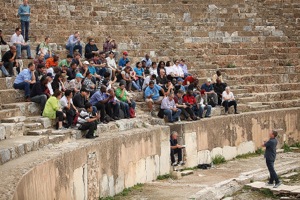
TheaterJesus’ warning was in my mind as we sat in the huge stone theater in Ephesus. Jesus must remain the center. Our core activity must remain telling others about the goodness of his kingdom. To cease telling others is to begin to die as a church.

Filed Under: church planting, Travel

Plumb lines

April 4, 2015 by Keith Seabourn Leave a Comment

When things go bad, it’s seldom because of a disagreement about the destination. It’s almost always a squabble over the day-to-day itinerary, the pace, or the best route to get from here to there. [Larry Osborne, Sticky Teams]

How do you build a team culture? Culture is about how we behave, why we behave the way we do in our organization or team. It’s more complicated that posters on the wall.

Rohan Dredge, in Creating and Discovering Culture, develops some ideas on creating culture. His point: “Listen deeply to what is already in the organisation and evaluate courageously who you need to be to accomplish your mission.” He proposed good parts of the process.

I was in an organization where the director gave a talk every year on the ethos of the organization. It was the first time I had experienced that kind of talk. It was a good part of the process and one which I continued when I became an organizational director.

But I think Larry Osborne has outlined an effective culture-shaping process in his book Sticky Teams: Keeping Your Leadership Team and Staff on the Same Page. The chapter is Staff Alignment and the topic is what Osborne calls plumb lines.

Here are some excerpts:

When things go bad, it’s seldom because of a disagreement about the destination. It’s almost always a squabble over the day-to-day itinerary, the pace, or the best route to get from here to there.

The most powerful tool I’ve found for overcoming these differences and for making sure that my staff is aligned in terms of their day-to-day values and decisions is something I call “ministry plumb lines.”

The purpose of plumb lines is to clarify how we plan to go about reaching the lost or glorifying God in this church at this time.

Effective leaders are almost always a little bit weird. They approach ministry and life a few degrees off center. That’s what sets them apart. They see and sense things that others miss. But sadly, most leaders have no tool to communicate their thought process or the unique values and perspective that drive their decisions. Again, that’s where the value of plumb lines comes in. It gives your staff and team something to gauge their own thought processes, assumptions, and decisions by. It gives them a track to run on.

If forced to choose between a great mission statement and a clear set of plumb lines, I’d choose the plumb lines every time. That’s because the devil and most disagreements are in the details. I find it relatively easy to get our entire staff headed in the same direction and aiming at the same goal. I find it much more difficult to ensure that everyone is taking the same route to get there.

I had wrongly assumed that alignment around our mission and goals automatically meant agreement about the best methods to get there.

What Osborne is talking about is creating an organizational culture that lives out the mission and values in daily decisions by every member of the organization. That’s culture.

Seeing an example of Osborne’s plumb lines in one area is very clarifying:

North Coast Church’s Plumb Lines for World Missions

  • Everyone needs Jesus. Since no one comes to the Father except through Jesus, we will give top priority to ministries and missions that actually bring people to Christ rather than those that focus solely on meeting physical needs.
  • All people are of equal value in the sight of God. Therefore, we will give top priority to ministries and missions where the harvest and return on investment is greatest.
  • The local church is God’s plan A. There is no plan B. Therefore, we will give top priority to ministries and missions that either plant churches or build up existing local churches.
  • Middlemen just get in the way. Therefore, we will not function as a middleman filtering communication or doling out financial support. Instead, we will encourage direct contact between our people and the missionaries and organizations they support. This will result in a less impressive missions’ budget, but it will produce far greater hands-on kingdom involvement.

Each begins with a cultural value statement then embeds that value of the church into a practical action. Osborne says this is how the church extends it’s values throughout the organization with consistency.

Who does your team need to be to accomplish your mission and how are you developing those values?

Filed Under: ccc, Leadership

Getting to 4th generation church multiplication

October 5, 2014 by Keith Seabourn Leave a Comment

“If you are not getting to fourth-generation church multiplication, it is probably because you are going too slow.”

I sat back in my chair in the restaurant and thought about the boldness of that statement. I had been invited into this conversation with George Patterson by Jared Nelms and Koudjo Nenonene of The Timothy Initiative. George is a retired church planting missionary.

George went on to say, “To get to 4th generation church multiplication, go fast. When you go fast, people focus on obedience and on following the commands of Christ. When you go slow, people focus on knowledge and on getting the details right. Multiplication is usually a casualty.”

George was saying that rather than focus initially on depth of knowledge and the right details, which will come over time, focus primarily on obedience and on rapid reproduction immediately after salvation. This missional DNA is the health that will grow churches. Depth and maturity will result over time as healthy churches obey Christ and grow.

George emphasized baptizing as soon as practical and engaging new believers in sharing Christ with their family and friends immediately after salvation. George also talked about the basic commands of Christ that needed to be taught in the first weeks of a new church. He identified seven general commands of Christ that he sees demonstrated in the early church in Acts 2:37-47:

  • Repentance, belief, and receiving the Holy Spirit through regeneration.
  • Baptism
  • The breaking of bread in the Lord’s supper
  • Loving your neighbor and impacting the community
  • Prayer
  • Giving
  • Making disciples

George feels that these basic commands of Christ are crucial in the first few weeks of a new believer’s life and the early weeks of a new church’s life. He said, “If you are not teaching the basic commands quickly, Satan will rush in and fill the new believers with good things, biblical things that keep them from crowning Christ as Lord. The key is obedience to Jesus’ commands, not knowledge of doctrine or theology.”

If you would like to hear more from George Patterson, I found an excellent interview online courtesy of Southeastern Baptist Theological Seminary.

Filed Under: ccc, church planting

  • « Go to Previous Page
  • Page 1
  • Page 2
  • Page 3
  • Page 4
  • Page 5
  • Page 6
  • Interim pages omitted …
  • Page 74
  • Go to Next Page »

Copyright © 2026 · Parallax Pro on Genesis Framework · WordPress · Log in