• Skip to main content

The Seabourns

  • Home
  • Blog
  • About Us
  • About God
  • Give

Keith Seabourn

Distance Learning Project

September 2, 2009 by Keith Seabourn Leave a Comment

The meetings part of my Africa trip are over. I’m partway into the travel remaining. I’m returned from Nairobi, Kenya to Johannesburg, South Africa on the first leg of 33 ½ hours of travel, leaving the hotel at 4:45 am until I touch down in Orlando on Thursday. The reclining cocoons of Business Class sure look nice as I walk past them to the Economy section!
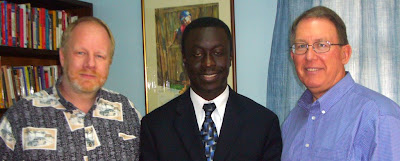
Yesterday, Chris and I met with Dr. Emmanuel Bellon, Vice Chancellor of Nairobi International School of Theology. We were joined by Nicholos Kimolo, Managing Director of Futuristics. Emmanuel’s vision of the need and urgency of distance learning in Africa is motivating. Nicholas seems a very competent consultant and advisor to come alongside and help implement the vision. Emmanuel shared the urgent need for trained leadership to guide the exploding church membership in Africa. Theological education schools in Nairobi do not graduate enough leaders to supply the new churches planted each year in just the city of Nairobi alone. It’s fairly normal for a church to see its trained pastor preach once every 3 months. The interim times are led by lay leaders and women, mostly untrained. There is an urgent need for trained leadership across the African continent.

Emmanuel sees distance education as an effective way to increase theologically-trained leadership beyond what resident schools are able to do. He began working on a plan 3 years ago, and really launched about a year ago. They have contracted Futuristics to help with the technologies needed.

As we talked, we identified several areas where my technology team in Orlando may be able to partner with this distance learning project. We have developed several systems that are needed in this project. It’s exciting to see the Lord enabling the work of our hands to be helpful to this distance learning project in Africa.

In addition to assisting with their current distance learning project, we agreed to a pilot project to test the ability to deliver distance learning in mobile phones. The current distance project seems focused on the centralized components of distance learning. I think the mobile device project can add value by addressing the end-user component of distance learning by providing a way for remote users to be trained without needing to have a computer and a high-speed internet connection.

This has been a very productive time. I am very aware of your faithful giving and praying. Kay and I are privileged to partner with you. We get to be your hands and feet, your personal representatives working with Dr. Bellon and others to develop new ways to help others grow and develop as Christ’s ambassadors.

More photos from Nairobi are online here.

Our September prayer calendar is online here.

On the journey together with you,
Keith & Kay

Filed Under: ccc, Ministry, Travel Tagged With: distance learning, elearning

Springbok and TOM

August 27, 2009 by Keith Seabourn Leave a Comment

Springbok

“We’re having Springbok pie with Chutney for dinner,” said our hostess Marie Dell. Springbok is a South African antelope. It tasted like venison (meat from deer) which I enjoy. But I’d never had it in a pie. A “pie” means a crust, something like a chicken pot pie. Chutney is a spicy relish made from vegetables or fruit. Good dinner!!!

I asked where the Springbok had come from. Marie’s husband Stefan had taken his discipleship group hunting. They had licenses for 5 springbok. We were eating from one of them.

Sounds like my kind of discipleship group! Maybe a transfer to South Africa will be in our future!

South African group

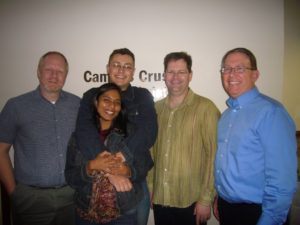
Nicholas and Pravani wanted to learn about TOM and other tools to build movements on their campuses. TOM is our nickname for a Facebook application called Together on Mission. TOM helps build movements through several momentum-building activities like

  • encouraging praying for one another
  • encouraging students to identify their “sphere of influence” whom they hope to influence for Christ
  • sharing stories contributed by students of evangelistic opportunities
  • helping students find a Bible study group and join it
  • reporting statistics of God’s activities on the campus

We recently released TOM version 1. Nicholas and Pravani quickly grasped how TOM could help them with their students. They saw how TOM could be used to launch ministries on campuses where they are not able to go.

More photos are available on our photo site.

Filed Under: ccc, Ministry, Travel

Community/Unity: not the absence of conflict, but the presence of a reconciling spirit

August 9, 2009 by Keith Seabourn 2 Comments

I read a great Bill Hybels’ article this morning on keeping Conflict above Ground: Building community out of controversy. Our pastor quoted from it during his sermon.

Here’s the beginning:

Unity isn’t the word we use to describe relationships at Willow Creek. The popular concept of unity is a fantasyland where disagreements never surface and contrary opinions are never stated with force. We expect disagreement, forceful disagreement. So instead of unity, we use the word community.

The mark of community—true biblical unity—is not the absence of conflict. It’s the presence of a reconciling spirit.

I love that phrase “not the absence of conflict, the presence of a reconciling spirit.” I think this is a mark of a healthy team, a healthy family, a healthy marriage, as well as a healthy church. I also like his concept of learning to fight fair. I think it’s really important. I use it in counseling others who are in conflict with someone.

Are you healthy in your conversations? Are you experiencing community?

Filed Under: ccc, Thoughts

Interesting approach to online ministry

August 8, 2009 by Keith Seabourn Leave a Comment

I read an interesting article this morning by Paul Watson, 6 Strategic Elements of Online Ministry and Gospel Planting. Starting from Luke 10:1-12, Paul outlines his 6 strategic elements. Paul’s 6 elements are helpful. Other insightful things for me are:

  • Start with existing communities, listening and conversing while looking for a person of peace (like a Cornelius, see Acts 10:1-2).
  • Work with the person of peace to begin a discovery bible study in which the person invites his friends (as Cornelius did, Acts 10:24).
  • Be willing to move from house to house, or community to community, looking for the God-fearers who want to learn more and are willing to take some leadership responsibility in bring others together.

What do you think about this strategy?

Filed Under: Ministry Tagged With: online ministry

Changing communication technologies changes thought processes also

August 7, 2009 by Keith Seabourn 1 Comment

A friend sent a link to a very provocative article, That’s why they call them browsers. Those who are seeking to use web technologies to communicate deep thoughts should read and re-read this article. The article is the Mars Hill Audio’s Ken Myers’ thoughts on Nicholas Carr’s Atlantic essay, “Is Google Making Us Stupid?” (July/August 2008).

Here is my response to the one who sent the article to me. Perhaps you have some thoughts. Comments welcome!

It is a very interesting set of thoughts, which were delivered in a medium that encourages avoiding deep thinking about his concerns!

I often think about previous shifts brought about by technological processes and wondered how people thought about them. For instance, I wonder what people were saying and writing in the years following the invention of the printing press. As the world moved from an oral society where great thoughts were read aloud by the few who could read, or shared around a circle after dinner, did they bemoan the loss of personalization where the reader/speaker could add to the story through voice inflections and dramatic reading/telling? Did they feel that the printed word encouraged an intellectualization rather than an emotionalization of a story? Did they feel that stories that communicated truth were being denigrated by words and sentences devoid of personal stories? When the time to think deeply moved from when the speaker/reader was available to when the listener wanted to delve into a book?

Much of Myers’ article could be re-written back to the transition from orality to print. For instance, “the fact that we read fewer books is a symptom of a deeper problem” might have been “the fact that we listen to fewer lectures is a symptom of a deeper problem”.

Or what about the 1950s when the telephone enabled personal conversation communication without being physically present?

Or the 1930s/40s/50s when movies replaced theater or television replaced movies? When people no longer dressed for a formal occasion, when intermission (with it’s social mingling) was replaced with popcorn and sodas purchased before entering the movie?

The internet communication media are not the first time we’ve experienced McLuhan’s observations that media “supply the stuff of thought, but they also shape the process of thought.. This won’t be the last time, either. I think the key is in Myers’ parting thoughts: “That requires the cultivation of disciplines and habits of attentiveness, practices which are robustly discouraged in the conventional experiences of everyday life in what is increasingly Google’s world.” It becomes more difficult in our modern-day world, but God is always at work in us, both to will and to work for His good pleasure.

Filed Under: ccc, Thoughts

  • « Go to Previous Page
  • Page 1
  • Interim pages omitted …
  • Page 28
  • Page 29
  • Page 30
  • Page 31
  • Page 32
  • Interim pages omitted …
  • Page 73
  • Go to Next Page »

Copyright © 2025 · Parallax Pro on Genesis Framework · WordPress · Log in