• Skip to main content

The Seabourns

  • Home
  • Blog
  • About Us
  • About God
  • Give

Leadership

Let God be God

September 2, 2011 by Keith Seabourn Leave a Comment

God just doesn’t fit into any box. We often appear to try to box God in by predetermining how he should work out a solution to my current problem.

I’m reading through Acts. It’s amazing how often God spoke directly with Paul, to warn him, to guide him, to encourage him.

So, why then did God use the son of Paul’s sister to overhear an ambush plot? Why did Paul believe him? (Acts 23:16-18)

It would have been easy for Paul to say, “Thanks, nephew. But I have this communication channel with God, you see. He speaks directly to me. In fact, he spoke to me just last night and said, “Take courage, for as you have testified to the facts about me in Jerusalem, so you must testify also in Rome.” He didn’t say anything about this ambush plot, so we’ll just let things go. I’m sure God can deal with it.”

No. Paul understood that God uses all sorts of ways to communicate with us. Paul understood a very important principle. Don’t put God in a box. Don’t predetermine how God will speak or how God will act.

Let God be God.

How do you sometimes box God in?
Filed Under: ccc, Leadership, Thoughts Tagged With: Leadership

An Experiment

April 21, 2011 by Keith Seabourn 3 Comments

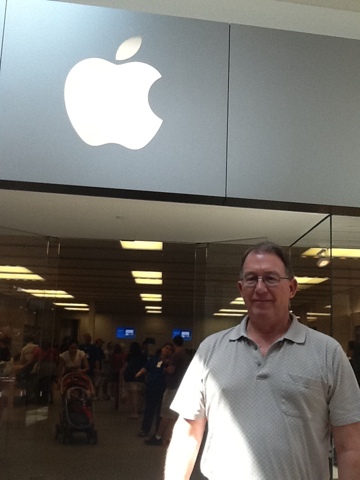
Outside the Apple storeI’m sitting outside the Apple store. Stunned. Replaying the conversation in my head.

“You can do without your computer for 5-7 business days, right?”

Gulp! “Um, I thought that if I called ahead, had an appointment, explained the exact problem in detail over the phone, made sure you had the parts, then you could repair it while I waited.”

“Well, we don’t have onsite repair personnel during the day. Only in the evenings. Whenever we need to put a computer on the bench, we allow 5-7 business days.”

“Oh, wow! The ONE thing I forgot to make sure about!”, I thought.

The Apple store Genius at the Genius Bar really had done an excellent job. She had been very courteous. She knew her stuff. She had quickly disassembled my Mac notebook and diagnosed the problem. I thought that the external case was bent preventing the DVD drive from ejecting a DVD. She had realized that the internal optical drive was bent also. AND SHE APPEARED TO BE ABOUT 20 YEARS OLD! How do they train this stuff into their people, I wondered. (But that is the topic of a future post, maybe.)

So, I’m leaving my primary leadership tool with the Geniuses. I lead a large, distributed part of the organization. Almost everything I do is through my computer: email, Skype, documents, calendar, blogging, engaging in discussion forums. I’m what is called a knowledge worker, and my tools are computer-based.

Fortunately, two recent actions make it possible for me to keep leading without much interruption.

My colleague Russ Martin influenced me to move everything I do into “the cloud.” I store all documents online. Dropbox. Google documents. Evernote.

My colleague Ken gifted me an iPad. We need to explore tablets. As part of my forward-looking leadership, I’ve wondered if I could use only a tablet for my work. Io think the Lord is giving me an opportunity to try it out! This blog post is my first action in the experiment!

I also have a very powerful smartphone (Android-based Google Nexus) and use it to read and reply to email, Google docs, Evernote…

With the combination of cloud-based documents, a powerful tablet iPad, and a powerful smartphone, I’ll test out life without a notebook computer.

I think I’m glad it’s the Easter holidays! Although they don’t count as business days, it is a change of focus for a while.

(Note: Perhaps the young Genius saw that my countenance had fallen, and because we have a business account, she declared that my notebook was “business critical” so I’m expedited to 1-2 day service.)

What tools do you use that are cloud-based?

Filed Under: ccc, gto, Leadership, Personal Tagged With: Leadership

Attention all grandads

April 19, 2011 by Keith Seabourn 1 Comment

Karin’s grandaddy passed away last week. She is a colleague. Karin wrote a powerful tribute to her grandaddy.

I would have liked Karin’s grandaddy. Anyone who values drinking a Coke with peanuts inside is my kind of a grandaddy! It’s a Seabourn family treat also. For the Seabourns, little red spanish peanuts are the kind for Cokes!

I’m a granddad to 4 wonderful grandchildren. I hope to be a grandad to them like Karin’s grandaddy was to her.

In Stephen Covey’s Seven Habits of Highly Effective People, Habit 2 is begin with the end in mind.

To begin with the end in mind means to start with a clear understanding of your destination. It means know where you are going so that you can better understand where you are now and so that the steps you take are always in the right direction.

Imagine your eulogy at your funeral. What would your friends say? What would you like them to say? Your family? Your co-workers?

Question: What do you want said at your funeral? What are you doing today to become that person?

Filed Under: Leadership, Personal, Thoughts Tagged With: Leadership, parenting

Simplify

March 28, 2011 by Keith Seabourn Leave a Comment

Have you noticed how things tend towards increasing complexity? As time goes by, layers are added. Things are piled on.

I like the approach promoted by Ward Cunningham, the inventer of the wiki. He asks, “Simplicity is the shortest path to a solution. You are always taught to do as much as you can. I say, forget all that and ask yourself, ‘What’s the simplest thing that could possibly work?’”

Have you noticed that things that begin as a neighborly conversation between co-workers can escalate into a policy-based, governance-moderated process? In an effort to codify into a repeatable process, complexity can be added to both the development process and to the final solution.

Let me apply this in the area in which I lead: technology development.

In The Power of Less, Leo Babauta suggests that simplicity is a two step process. To paraphrase Babauta and apply it to technology systems development, the two step process is: identify the essential elements of what your solution should do, and then eliminate the rest. In the era of extreme programming and rapid application development, don’t build into this version what is not needed until next version. (Kind of the technology implementation of Jesus’ teaching “do not worry about tomorrow, for tomorrow will worry about itself. Each day has enough trouble of its own.” (Matthew 6:34)

Why do we tend towards increasing complexity?

I think it is driven by a scarcity mindset rather than abundance mindset. Complexity is an effort to become efficient because time and money is scarce. But if we can find ways to keep things as simple as possible, we open opportunities for others to engage with us. We can leverage our network.

Jesus contrasted complex prayer and simple prayer (Matthew 6:7-13).

And when you pray, do not keep on babbling like pagans, for they think they will be heard because of their many words [added complexity]. Do not be like them, for your Father knows what you need before you ask him.
“This, then, is how you should pray:

“‘Our Father in heaven,
hallowed be your name,
your kingdom come,
your will be done,
on earth as it is in heaven.
Give us today our daily bread.
And forgive us our debts,
as we also have forgiven our debtors.
And lead us not into temptation,
but deliver us from the evil one.’

Simple prayer. Only the essential elements. What is the simplest prayer that can convey my heart?

Like simplicity in prayer, simplicity in technology is a powerful path towards effective solutions.

In what ways have you seen simplicity move the mission forward?

Filed Under: ccc, gto, Leadership Tagged With: Leadership, technology development

Operational and Strategic Technology

March 21, 2011 by Keith Seabourn Leave a Comment

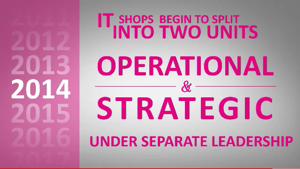
Strategic and operational IT

By 2014, Information Technology shops will begin to split into two units — operational and strategic — under separate leadership.

So claims an interesting video presentation by the Pink Elephant group, a leader in IT management. The entire video is interesting. This claim is made at the 7:56 point in the video.

We discussed this video at the recent Global Technology Leaders meeting in Thailand. It was an interesting discussion.

What is really interesting is that this shift has been happening in my own organization for several years. What the Pink video calls “strategic IT” is what we call Virtually-Led Movements technologies. These are the externally-facing technologies that enable accomplishing the mission in more direct ways. What the Pink video calls “operational IT” is still very important. I appreciate the internally-facing operational technologies every time that donations to my ministry are processed in a safe and timely manner, every time my salary and reimbursements are paid, every time the network allows me to print a document.

VLM technologies are critical to accomplishing the mission of Campus Crusade for Christ. Just my own small team has several of these technologies that we are implementing:

  • Global ConneXion
  • Global Identity
  • mLearning

What do you think about their claim that the strategic and operational areas prosper best when under separate leadership?

Filed Under: ccc, gto, Leadership Tagged With: Leadership, vlm

  • « Go to Previous Page
  • Page 1
  • Page 2
  • Page 3
  • Page 4
  • Interim pages omitted …
  • Page 6
  • Go to Next Page »

Copyright © 2025 · Parallax Pro on Genesis Framework · WordPress · Log in